Category Archives: Money

Capitalism can be amazing

Not always. Sometimes. The American system has been so distorted through government interference and by third parties like insurance, that few areas of pure free market exist. The internet has areas of freedom. Car sales are another area. And a few others. But what brought it to mind was when I set out to get eyeglasses yesterday. I had seen an ad on TV from Vision 4 Less promoting their ‘Sale! This week only!‘ I realized I better get off my duff and go check it out! Because they are new on south Duff, I was hoping to get right in for the examination and I was. 15 minutes and $72 dollars later I had my prescription and was looking at frames.

20 minutes after that the gal was taking the 2 frames to the back where they match the lenses to the frames. In 1 hour no less. So I went to go run a few errands. In less then 1 hour I got a text message saying they were done. I had waited maybe 5 minutes for the examination, 10 minutes for the frame order. The whole thing didn’t take more than 2 hours I don’t think. The 2 pair of glasses only cost $117 (versus $68) because I had chosen UV and scratch protection 1 year warranty. I think those 2 are kind of like “underbody coating” on a new car. So I spent $50 more than necessary. Still beats the $348 or so I’d spend normally.


Pawn Stars

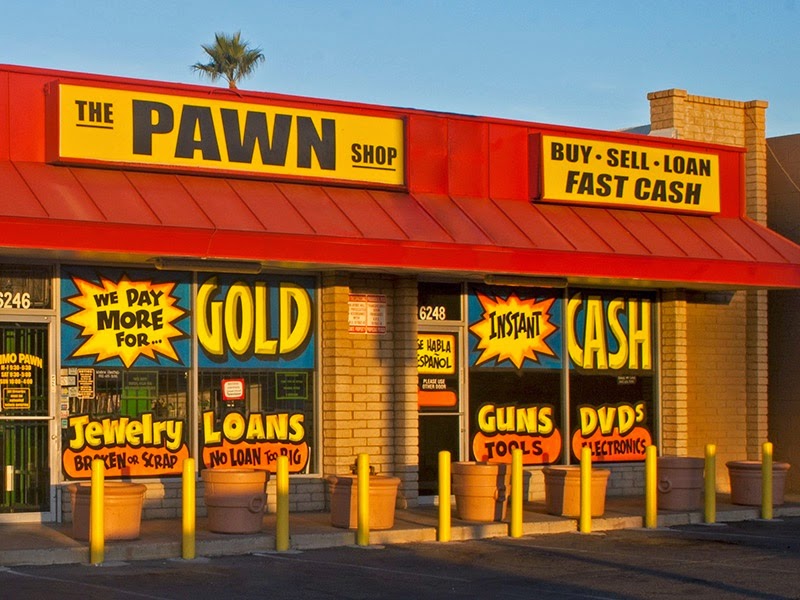
Pawn shops are a funny place. I’m guessing a lot of the more genteel Iowans have never been in one. Its kind of an economic ‘dirty book store’. Aside from the palm tree growing out of the top of this one, it could be anyone of the ones dotting the Iowa landscape. My guess is very few of the items that end up there were ever dropped off with the intention of going back for them. They end up being thrift stores for tools, jewelry, electronics and guns. I remember reading one time that when pawn shops and checks into cash (payday loan) places spring up, its an indicator that a neighborhood is in full blown decline. In Ames another indicator was the explosion of clothing consignment shops.

What I don’t understand about pawn shops is their business model. I get the part about they have to ‘buy wholesale’ and ‘sell retail’. They have to pay employees, the lease and the light bill. so their goal is to pay X and sell for 2X. But that’s where it gets fuzzy for me. I don’t know about jewelry and electronics, but I do know about tools and guns. I saw a nice little 20 piece socket set yesterday for $16 bucks. You could buy it new at Walmart or Lowes for about that or a few bucks more. Why would you pay the same amount for used?

Another area is guns. You can buy a brand spanking new gun (and a good one at that) for $136 dollars at a gun show. A Taurus Spectrum .380. You can buy a new Hi-Point 9mm for $139. So imagine my surprise when I saw a used Ruger LCP for $200 at the pawn shop on Lincoln Way in Ames. New price is $219 (LCP II new price is $299 or on sale for $249). Are you wanting to sell guns or store them? They have a used Taurus PT111 for $189 I believe, a new G2C (its replacement) only goes for $215. So in both cases only $20 bucks more would buy you new of the same item, and you wouldn’t have to worry about what some nimrod previous owner did to the gun on the used market!

Assuming they do the same thing for electronics and jewelry, I don’t see how they keep the doors open. Anyone who knows market value on the items would never buy them! There must be a lot of unaware consumers. You know in the example above they didn’t give a penny more than $90 for the LCP, they could actually sell it for $130, instead of storing it for $199. Just don’t get it. “Store of wealth” (the retained value of an item), its a strange business. They seem to stay in business. You just think they could make a lot more money if they were actually interested in selling stuff instead of just ripping people off.


Is it better? Or worse?

Sometimes I don’t think people see too clearly. That’s not good when certain major aspects of a society have gone off the rails for several generations now. Corporate America has had things tilted in their favor so long no one sees how out of kilter they are. Drug prices are 10 – 50 times what they are in Mexico because our big pharma lobbyists (the single largest lobbying concern) have paid Congress to make it that way. Years ago I did a post based on an USA Today article from 2013 showing how roughly 546 people in the world owned 50% of the wealth.

That figure has now shrunk to the 8 richest people. That’s nuts. I’m not arguing against a free market, I’m arguing for one. I don’t think we have a free market, I think we have a slave market. I’m suggesting government and business have colluded to put labor at a severe disadvantage. I’m suggesting the working man has the deck stacked against him. I mean for God’s sake, that’s why K Street exists, to buy an advantage. They don’t give billions each year to Congress because they like them, they expect something. A bang for their buck.

In 1955 the median income for the typical worker was around $4,418. Forbes says the typical CEO made 20 times what the worker did in 1955. I’ve also seen 30:1 thrown out a few times as a common ratio in the 1950s, but 20:1 seems the majority of opinion. Using that ratio (20:1) and rounding up the worker salary to $5,000, that puts the average CEO in the 1950s making $100,000. Using an inflation calculator, that puts a typical annual salary today at $47,425. CEO pay adjusted for inflation would be $948,514.

While $47K is a typical good salary today, $950K is not even close to what a CEO makes. $12.1 – $14.3 million is a common quoted figure for CEO salary. CNBC has it at $15.5 million a year. That doesn’t begin to cover all the angles. That’s where a more accurate “compensation package” figure comes in. One that includes retirement, life insurance, stock options, incentives and a host of other items. These same sites all seem to agree 300 times is what a CEO now makes compared to the line worker. 300 x. In the 1950s it was 20 x.

There are a couple of other factors that further prove the point. In the 1950s corporation paid dividends to shareholders. Historically this was 4% to 6%. Companies don’t pay dividends for the most part nowadays. The few that do think they’re doing us a big favor with 1.5% to 2%. The average for the ones who do on the S&P 500 being 1.5%. People are being played for fools. Its not a Left/Right thing, its both.

My main beef with people is they have been swallowing the ‘company’ line for so long they believe the crap they’re being told. Perhaps the best figure I’ve come up with is the one for the rarified atmosphere of the top CEOs, $300,000,000. That 1 salary split up would  take 60,000,000 minimum wage workers from $7.25 an hour to $12.25. Taking them from a minimum wage to a living wage. 1 man.

Will the crisis ever come?

After watching a ton of apocalyptic videos (like: “The Imminent Market Collapse!”) I saw one with a different take on the situation. This guy believed the same way, that we have a crooked monetary system and that the Federal Reserve are manipulating the markets, but he believed that the Fed is so far out of control that they can do anything they want. That they are Masters of the Universe so to speak and that normal market forces no longer apply. Evidently we’re supposed to believe they can run a $2 trillion dollar deficit on a $3 trillion dollar economy. (If they can print $5 trillion dollars out of thin air, why not $20? A $100 trillion?)

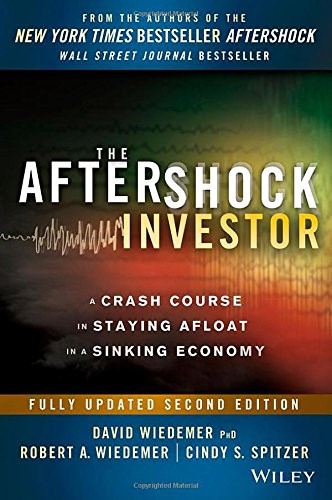
I’m beginning to believe him, especially after reading the book ‘The Aftershock Investor‘ (pictured above). It was written in 2014 and tried to convince readers a monetary system based solely on a central bank inflating bubbles forever was not sustainable. 4 years later and we seemingly are no closer to the collapse the authors and many others have been predicting for decades that was supposedly just around the corner.

The basic premise of all these guys is that basically all developed nations in the world have a debt based fiat currency system that is insolvent (Europe, China, everybody). That we can no longer service the deficits, let alone ever pay off the debt. We are floating bond sales just to pay the interest (the equivalent of an individual borrowing from the credit union to pay the interest on his credit card, not a home equity loan to pay it off). We’ve squandered the SSA and Medicare money as it came in on current spending, rather than leaving it in the “trust funds”  they told us they were doing. Congress of course never thinking beyond the next election.

The national debt has really begun to take off. When Trump took office in January 2017 it was a couple of months before the debt officially hit $20 trillion. Today (11/18/18) the National Debt Clock shows $21,747,000,000,000 and change. It may grow by $2 trillion just in Trump’s first 2 years. That is almost the entire amount it grew in Reagan’s entire 8 years. Its a snowball on a downhill slide. You don’t want to be at the bottom of the hill.

Once again the authors took way too long to give us their recommendations on how to prepare for the crash (367 pages). Oh, and if you really want to prepare, you need to buy their newsletter for $420 bucks a year or hire them as private consultants to guide your portfolio decisions. (“More money can be made selling advice, then following it.”)Whether or not “the big crash” does come, we did indeed have a nasty turn in ’08. There’s no getting around that, and we’ve just piled more personal and government debt on top of that debt crisis. So if a “Global Financial Crisis” can happen once, it can surely happen again.

They were pretty vague on the trigger points to watch for, but 2 did stick out. One was when the interest on 10 year treasuries hit 4% or 5%. The other was when gold starts to spike from its current position of $1,200 an ounce. A lot of people got burnt on gold when they bought the 2011 high of $1,900 an ounce. The authors (Dave and Robert Wiedemer and Cindy Spitzer) think the bond market will shut itself down when interest rates spiral out of control. They think the government will shut the stock market down for longer and longer periods of time to forestall a complete collapse.

I know in Greece a couple of years ago during their banking crisis the ATM’s didn’t work. They were literally taking money out of customer accounts and safe deposit boxes to fund their operations. In the event of a 1930’s style depression, all bets are off as to what the government is capable of. The only thing we do know is that the banks will be taken care of, the customers be damned. Hey, they didn’t buy Congress for nothing.

The book spends an inordinate amount of time warning you of the obvious. Stay liquid, pay off your debt, don’t be a spendthrift, don’t have a job that depends on a customer’s discretionary spending (there will be little left but money for necessities in a true crash). Below are some of the (once again obvious) vehicles they recommend, mostly revolving around hard assets.

  • Treasury Inflation-Protected Securities
  • Dividend paying stocks
  • Gold
  • Gold ETFs
  • Land
  • Commodities
  • Cash
  • Inverse stock ETFs
  • Inverse bond ETFs
  • Foreign currencies

And, perhaps most importantly, being prepared and thinking for yourself. Just because the lemmings are going off the fiscal cliff, doesn’t mean you have to. Don’t have 100% exposure to the market when it collapses. Not having the cash when its time to cherry pick the bargains at the bottom. Not listening to the “experts” on TV who saw none of this coming (and certainly didn’t warn you if they did). But as I pointed out, we may be in such a surreal time of Fed unaccountability, that the hard crash may not come at all. They may just gobble up our wealth the silent way, through inflation.

[And once again it boggles the mind that with a government on the verge of bankruptcy, it never occurs to anyone that its about time that ‘non-profits’ (hospitals & churches) ante up. Its ridiculous to say hospitals are non-profit, and defining what a ‘church’ is, is impossible and irrelevant. Our government refuses to take its head out of the sand and acknowledge the severity of the situation.]




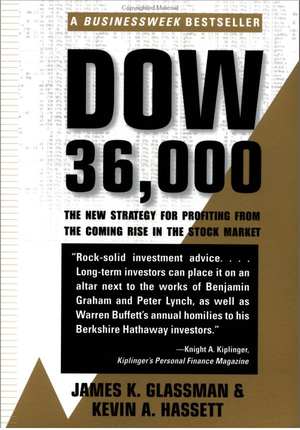
“Dow 36,000”

What a fun and quick read that was. Glassman and Hassett spent the first half of this book from 1999 spouting gibberish about companies being in their ‘adolescence’ and making up terms like PRP (perfectly reasonable price). It was fun to have the advantage of hindsight as they extoll the greatness of GE then, as it sits now about $3.38 away from being considered a ‘penny stock’ (stocks below $5). Reassuring readers that the great AOL was fine to have a P/E of 391 (the prudent high-end for a tech stock maybe being 40). Many other tech names that blew up never to be heard from again a year after they wrote this.

All the experts that came on TV after the tech bubble popped explaining how they saw it coming (then why didn’t you warn anyone?). To be fair to the authors they could not have been expected to foresee the other two minefields of the decade, 9/11 and 08’s Global Financial Crisis. Nevertheless it was a blast to have “experts” (and a publisher who paid for this mess) display such colossal ignorance. It makes me feel not quite so stupid for all the mistakes I make in the market.

[When this book was written in 1999 the DOW was at 9,000. It peaked in January of this year at about 26,600. It promptly sank and today sits at 25,289. So, 20 years later we are not quite having tripled in 2018, what they predicted to have quadrupled by 2005.]

Fidelity Investments

Oh my gosh, I think I’ve found a good one! There are a lot of clunkers out there in the investment world. T. Rowe Price was such a step up over American Century, Price funds actually made money! Then I wanted a brokerage account to trade ETFs and stocks and came across Vanguard. Vanguard has a lot of things going for it. Fidelity has the edge in a couple of areas. They don’t have the high minimum purchases with Certificates of Deposit and Corporate Bonds. [With interest rates rising, 20 year corporate Bbb bonds are paying 7.58%!] Fidelity lets you buy them at their face value of $1,000 each. You can only do that sometimes at Vanguard.

The other winning deal maker with Fidelity is the $4.95 per trade. Not as an introductory offer, but their regular price. AND! If that wasn’t enough, they have a group of zero expense ratio mutual funds! I know where I’m moving my money the first of the year! Its a no-brainer.

The worst book ever written?

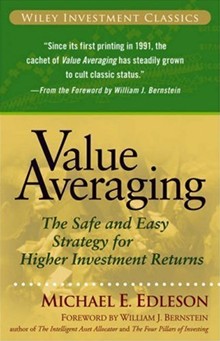
Oh my God what a waste of time and money! Author Michael Edleson comes up with this ridiculous (and impractical) spin on the tried and true dollar cost averaging, and calls it “value averaging” just to sell a book. He spends 232 pages trying to convince you to try it his way over a 45 year work career and your retirement fund will achieve an entire .78% return  over dollar cost averaging. Good grief. His complicated strategy has you recalculating your basic investment each month! He even has you selling off shares in an up month! The whole thing is asinine. The new Roth IRA limit for 2019 is $7,000 dollars (age 50+, $6,000 otherwise). Divide that up by 12 and you have $553 dollars a month to put into a low cost Vanguard ETF index fund. Edleson would have you up all night with a financial calculator and reams of paper! [As a public service, I am going to throw this book away, rather than sell it back to Half Price Books for a $1 dollar towards my next book.]

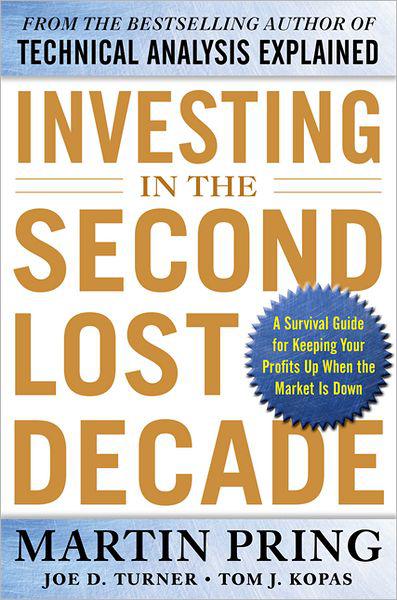
Right on the tail of that book is one by Martin Pring called, ‘Investing in the Second Lost Decade’. They had a good premise, the 2000’s were a complete wash with the Tech Bubble and The Global Financial Crisis. Between the Federal Reserve and Wall Street shenanigans, the small investor was taken to the cleaners while the big banks were bailed out and given bonuses. Instead of prepping people how to cope with government and banking malfeasance, Pring pushes his new business cycle theory to sell a book and warm people up to the idea of investing in his EFT of the same theory, DBIZ. Pring wasted 234 pages and killed God knows how many trees for his idiotic book. You know his theory didn’t hold water, his ETF introduced at the end of 2012 was closed by 2015. “Lack of investor interest“.

Wall Street of course is nothing but a den of liars and thieves and they have continued that into book sales. I think cross matching the results from 5 different “Top 10 Best Investing Books” search, would yield some classically good books instead of these clunkers. Its kind of like the secret is finally out on fund managers, they can’t beat the index. For all their high prices and fancy suits, 90% of them can’t beat an index fund.

Going behind the curtain

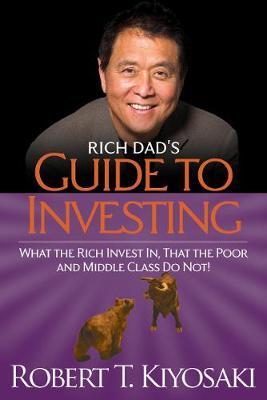
Knowledge is power. Hence the reading quest. As the list of books that I have read on investing grows, I’ve found that even the worst book (‘The Big Short’, by Michael Lewis), has nuggets of value. Then I stumble upon a book that takes you “behind the curtain”. The one that doesn’t just tell you how to be the best investor you can be in this world, but explains that there is a whole other world out there! One you never knew about. The key is in the subtitle, “What the Rich Invest In, That the Poor and Middle Class Do Not!”

Most of the books I’ve read try to turn the layman into a stock analyst. The stock market might be a path to wealth for some. But what Robert Kiyosaki explains in Rich Dad, is that rather than being satisfied with chasing the S&P 500 for 21% in a good year, there’s a 1,000% return you can have in their world. You just have to know how to get there. This book is the map to get you there. The first 28 pages have taught me more in a way than all the other books. The Yellow Brick Road to wealth is a paradigm explained in this book. That path may be through stocks, but there are many other paths.

Seeking Alpha

Seeking Alpha is a crowd-sourced content service for financial markets founded in 2004 by former Wall Street analyst David Jackson. It is also about the most relevant site for the individual investor. Its philosophy is a play on “wisdom of the crowd” for stocks & bonds. Most sites like Market Beat and others come across as free sites, but in reality are just there to draw you in to get you to pay for their “pro” version. Between Yahoo Finance, MSN Money and Seeking Alpha, I think you’d have to be a very serious investor to make it worthwhile to buy a subscription to the Financial Times, WSJ or some other bigtime publication. About the only pay sight I’m contemplating is the Motley Fool subscription for $99.

[“Alpha is a measure of the so-called active return on an investment, the performance of that investment compared to a suitable market index. An alpha of 1 means the investment’s return on investment over a selected period of time was 1% better than the market during that same period, an alpha of -1 means the investment underperformed the market.”]

How do they do it?

Wednesday (October 10, 2018) all stock markets around the globe starting with the DOW went down roughly 3%. Today, they all followed with a 2% drop. That 5% over 48 hours was half the distance to an “official” correction of 10%. For the life of me I will never understand how the world simultaneously lost 5% of its worth in 2 days. How do they coordinate this crap? You have the feeling that insiders operating in the bowels of the industry could tell you in a heartbeat. I’m also fairly confident we’ll never find out. Much like who shot JFK.

Tech, financials, consumers, housing, retail, telecom, you name it! They ALL cratered on the same day? Around the world? How?? The only thing I know that went up was gold and silver.  

You get the feeling the word went out, “Okay, we screw the public today!” I’m starting to read between the lines on the financial shows. They are always harping about interest rates. I figured out why. No one operates on a solid financial footing. They are all leveraged out the whazoo. Why not? Bankruptcy laws are so screwed up they can’t lose! They’ll just “reorganize” if the bottom falls out. So if interest rates rise they start to squeal because they’re financed out to the bank on everything they do. Modern business is founded on debt. They operate by the seat of their pants. Pop the bubble and the whole thing collapses.

They are all allowed to fudge the facts so bad on their Quarterly’s and Annual Statements you’d never know how tenuous their house of cards is. Robber Barron’s like John D. Rockefeller would tip their hat to these guys. But interest rates are only one of the items they’re whining about right now, the other is tariffs. The tariffs haven’t even begun to kick in with all the exemptions and the big numbers not set to kick in until the first of the year.

So there it is. Interest rates and tariffs are the excuse, but the real reasons are only known to the man behind the curtain, and he’s not talking. 

I’m starting to read quite a number of books on the subject, 20 Must Read Investing Books , but after yesterday I’m beginning to think they are all irrelevant. The big market movements, or something like the Global Financial Crisis of ’08 shows that you are like a piece of driftwood when the tide comes in, you have no control where you are going. You are just along for the ride. All the knowledge in the world might let you tinker around the edges in the good times, but when that man behind the curtain decides to screw you, look out.