Author Archives: Iowa Life

Unknown's avatar

About Iowa Life

Experiencing life in Iowa.

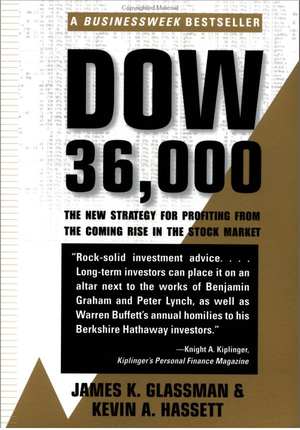
“Dow 36,000”

What a fun and quick read that was. Glassman and Hassett spent the first half of this book from 1999 spouting gibberish about companies being in their ‘adolescence’ and making up terms like PRP (perfectly reasonable price). It was fun to have the advantage of hindsight as they extoll the greatness of GE then, as it sits now about $3.38 away from being considered a ‘penny stock’ (stocks below $5). Reassuring readers that the great AOL was fine to have a P/E of 391 (the prudent high-end for a tech stock maybe being 40). Many other tech names that blew up never to be heard from again a year after they wrote this.

All the experts that came on TV after the tech bubble popped explaining how they saw it coming (then why didn’t you warn anyone?). To be fair to the authors they could not have been expected to foresee the other two minefields of the decade, 9/11 and 08’s Global Financial Crisis. Nevertheless it was a blast to have “experts” (and a publisher who paid for this mess) display such colossal ignorance. It makes me feel not quite so stupid for all the mistakes I make in the market.

[When this book was written in 1999 the DOW was at 9,000. It peaked in January of this year at about 26,600. It promptly sank and today sits at 25,289. So, 20 years later we are not quite having tripled in 2018, what they predicted to have quadrupled by 2005.]

Fidelity Investments

Oh my gosh, I think I’ve found a good one! There are a lot of clunkers out there in the investment world. T. Rowe Price was such a step up over American Century, Price funds actually made money! Then I wanted a brokerage account to trade ETFs and stocks and came across Vanguard. Vanguard has a lot of things going for it. Fidelity has the edge in a couple of areas. They don’t have the high minimum purchases with Certificates of Deposit and Corporate Bonds. [With interest rates rising, 20 year corporate Bbb bonds are paying 7.58%!] Fidelity lets you buy them at their face value of $1,000 each. You can only do that sometimes at Vanguard.

The other winning deal maker with Fidelity is the $4.95 per trade. Not as an introductory offer, but their regular price. AND! If that wasn’t enough, they have a group of zero expense ratio mutual funds! I know where I’m moving my money the first of the year! Its a no-brainer.

The worst book ever written?

Oh my God what a waste of time and money! Author Michael Edleson comes up with this ridiculous (and impractical) spin on the tried and true dollar cost averaging, and calls it “value averaging” just to sell a book. He spends 232 pages trying to convince you to try it his way over a 45 year work career and your retirement fund will achieve an entire .78% return  over dollar cost averaging. Good grief. His complicated strategy has you recalculating your basic investment each month! He even has you selling off shares in an up month! The whole thing is asinine. The new Roth IRA limit for 2019 is $7,000 dollars (age 50+, $6,000 otherwise). Divide that up by 12 and you have $553 dollars a month to put into a low cost Vanguard ETF index fund. Edleson would have you up all night with a financial calculator and reams of paper! [As a public service, I am going to throw this book away, rather than sell it back to Half Price Books for a $1 dollar towards my next book.]

Right on the tail of that book is one by Martin Pring called, ‘Investing in the Second Lost Decade’. They had a good premise, the 2000’s were a complete wash with the Tech Bubble and The Global Financial Crisis. Between the Federal Reserve and Wall Street shenanigans, the small investor was taken to the cleaners while the big banks were bailed out and given bonuses. Instead of prepping people how to cope with government and banking malfeasance, Pring pushes his new business cycle theory to sell a book and warm people up to the idea of investing in his EFT of the same theory, DBIZ. Pring wasted 234 pages and killed God knows how many trees for his idiotic book. You know his theory didn’t hold water, his ETF introduced at the end of 2012 was closed by 2015. “Lack of investor interest“.

Wall Street of course is nothing but a den of liars and thieves and they have continued that into book sales. I think cross matching the results from 5 different “Top 10 Best Investing Books” search, would yield some classically good books instead of these clunkers. Its kind of like the secret is finally out on fund managers, they can’t beat the index. For all their high prices and fancy suits, 90% of them can’t beat an index fund.

Going behind the curtain

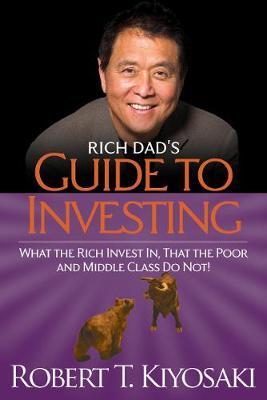
Knowledge is power. Hence the reading quest. As the list of books that I have read on investing grows, I’ve found that even the worst book (‘The Big Short’, by Michael Lewis), has nuggets of value. Then I stumble upon a book that takes you “behind the curtain”. The one that doesn’t just tell you how to be the best investor you can be in this world, but explains that there is a whole other world out there! One you never knew about. The key is in the subtitle, “What the Rich Invest In, That the Poor and Middle Class Do Not!”

Most of the books I’ve read try to turn the layman into a stock analyst. The stock market might be a path to wealth for some. But what Robert Kiyosaki explains in Rich Dad, is that rather than being satisfied with chasing the S&P 500 for 21% in a good year, there’s a 1,000% return you can have in their world. You just have to know how to get there. This book is the map to get you there. The first 28 pages have taught me more in a way than all the other books. The Yellow Brick Road to wealth is a paradigm explained in this book. That path may be through stocks, but there are many other paths.

Seeking Alpha

Seeking Alpha is a crowd-sourced content service for financial markets founded in 2004 by former Wall Street analyst David Jackson. It is also about the most relevant site for the individual investor. Its philosophy is a play on “wisdom of the crowd” for stocks & bonds. Most sites like Market Beat and others come across as free sites, but in reality are just there to draw you in to get you to pay for their “pro” version. Between Yahoo Finance, MSN Money and Seeking Alpha, I think you’d have to be a very serious investor to make it worthwhile to buy a subscription to the Financial Times, WSJ or some other bigtime publication. About the only pay sight I’m contemplating is the Motley Fool subscription for $99.

[“Alpha is a measure of the so-called active return on an investment, the performance of that investment compared to a suitable market index. An alpha of 1 means the investment’s return on investment over a selected period of time was 1% better than the market during that same period, an alpha of -1 means the investment underperformed the market.”]

Polly Browne and Pickettywitch


polly browne

In 1947 a goddess was born in the British Isles named Polly Browne. I first came across her music on YouTube with the song, Same Old Feeling with her group Pickettywitch from 1970. I thought I was gone with that one. Then I heard, Freedom from her ‘Blues Collection’. That’s when I realized what gone was. When nature combines to put the voice of an angel with the face of an angel, that’s pretty awesome. Estimating I “discovered” her two years ago, that puts me at exactly… 46 years late! My track record is complete.

They need you

The greatest dog that ever lived recently passed over the Rainbow Bridge, and although I couldn’t stop that, I thought I’d see what I could do for some very fine pooches still here. There are a bunch that need you. Here in Ames we have a Cadillac animal shelter courtesy of endless tax dollars. So I found two needy shelters in Des Moines and found out what they needed. Furry Friends has a shelter at 1723 Grand, 50309. They are like the Bethel Mission of the animal world. They need food, money and volunteers! The kitties can socialize with each other, but those doggies need walked and loved!

Another great place is Animal Lifeline of Iowa. They are at 4521 S.E. 14th Street, 50320. They are a special needs, no-kill shelter. I have mixed feelings about devoting all those resources for a small group of results, but you can’t argue they aren’t trying to save the neediest cats and dogs out there. The numbers that need us are so great… They have been around for decades and are more organized. They have an office staff that can acclimate you to their wish list (and give you one). Animal Lifeline Amazon Wishlist

For dogs (and cats too I imagine), some of the really good quality dry foods are Taste of the Wild (high prairie formula), Wellness Complete and Wellness Core, and Solid Gold (Sun Dancer and Barking at the Moon). Those are not the only brands of course, but they are 3 that consistently show up on “Best 10” dry dog food lists. Dog foods have come a long way in the past 10 years and are so vital to energy, coat, nails, mood and brain function. And of those 3, Wellness and Taste of the Wild seem to be duking it out for 1-2. I plan to check back with the shelters and see if the dogs have a taste preference.


Best Reviews

Athena

3-legged Eileen

Possessive kitten


“Doing the most good”

The Salvation Army Mission Statement

The Salvation Army, an international movement, is an evangelical part of the universal Christian Church. Its message is based on the Bible. Its ministry is motivated by the love of God. Its mission is to preach the gospel of Jesus Christ and to meet human needs in His name without discrimination.

You can write us at :
The Salvation Army National Headquarters
615 Slaters Lane
P.O. Box 269
Alexandria, VA 22313

How do they do it?

Wednesday (October 10, 2018) all stock markets around the globe starting with the DOW went down roughly 3%. Today, they all followed with a 2% drop. That 5% over 48 hours was half the distance to an “official” correction of 10%. For the life of me I will never understand how the world simultaneously lost 5% of its worth in 2 days. How do they coordinate this crap? You have the feeling that insiders operating in the bowels of the industry could tell you in a heartbeat. I’m also fairly confident we’ll never find out. Much like who shot JFK.

Tech, financials, consumers, housing, retail, telecom, you name it! They ALL cratered on the same day? Around the world? How?? The only thing I know that went up was gold and silver.  

You get the feeling the word went out, “Okay, we screw the public today!” I’m starting to read between the lines on the financial shows. They are always harping about interest rates. I figured out why. No one operates on a solid financial footing. They are all leveraged out the whazoo. Why not? Bankruptcy laws are so screwed up they can’t lose! They’ll just “reorganize” if the bottom falls out. So if interest rates rise they start to squeal because they’re financed out to the bank on everything they do. Modern business is founded on debt. They operate by the seat of their pants. Pop the bubble and the whole thing collapses.

They are all allowed to fudge the facts so bad on their Quarterly’s and Annual Statements you’d never know how tenuous their house of cards is. Robber Barron’s like John D. Rockefeller would tip their hat to these guys. But interest rates are only one of the items they’re whining about right now, the other is tariffs. The tariffs haven’t even begun to kick in with all the exemptions and the big numbers not set to kick in until the first of the year.

So there it is. Interest rates and tariffs are the excuse, but the real reasons are only known to the man behind the curtain, and he’s not talking. 

I’m starting to read quite a number of books on the subject, 20 Must Read Investing Books , but after yesterday I’m beginning to think they are all irrelevant. The big market movements, or something like the Global Financial Crisis of ’08 shows that you are like a piece of driftwood when the tide comes in, you have no control where you are going. You are just along for the ride. All the knowledge in the world might let you tinker around the edges in the good times, but when that man behind the curtain decides to screw you, look out.


It just doesn’t matter!

Wall Street types are often referred to as sharks or wolves, and for good reason, they will eat you alive. They will keep your head spinning with charts, graphs and other visuals. The jargon is designed to keep their shenanigans a mystery. They will refer to “retail investor panic” in derogatory terms while in fact it is them that cause the market to gyrate if the Fed Chairman farts. “The DOW rose today on news that we fabricate solely to advance our own narrative…”

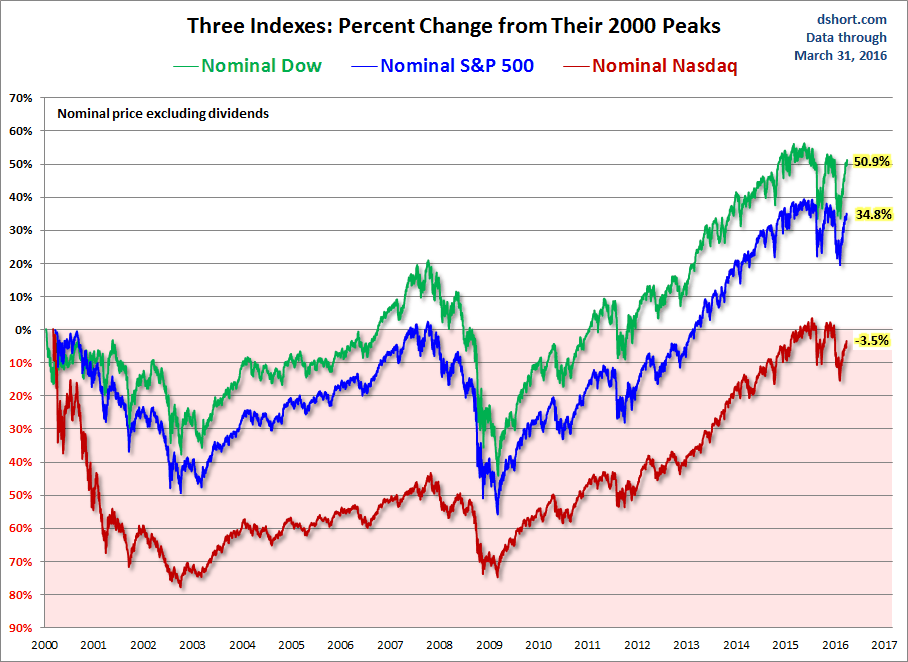
They will have you convinced that it is only learned professionals with their technical analysis that can decipher the black magic that is the markets. Bull hockey. I have 3 charts from the past 20 years that lay bare the folly of Wall Street’s conventional wisdom, or lack thereof. The top chart of the DOW, S&P 500 and the NASDAQ is a good example. Large cap or small cap, aside from the valuations, those 3 indexes have moved in lockstep for 20 years!

The next chart (below) involves a couple of indexes showing what their “foreign diversification” does for you, nothing. You can see from the dips in ’01 and ’08 that there is complete correlation with U.S markets! So it just doesn’t matter! Small stocks, big stocks, domestic stocks, foreign stocks, when the market is going down, we all go down. Its a little depressing really. It doesn’t matter how smart  you are or how stupid you are. How bold you are or how timid. How patient you are or how impulsive you are.

Unless the overall market goes up, you’re not going up. If the overall market goes does down, it doesn’t matter how diversified you are, you’re going down. The only advice worth a darn is the one about staying liquid. You have to keep a sizeable reserve of cash to pour into the market during major downturns (and the ability not to listen to the press when it does). During the last 45 years there have been just 4 major corrections (buying opportunities) that mean the difference between a so-so retirement and a “wow” retirement. Depending on how you play them.

Put another way, 1929 wasn’t the greatest market disaster the world has ever seen, it was the greatest buying opportunity the world has ever seen! If you had kept a percentage of your money in cash. You can’t be 100% invested in case of a crash. 

Those were the periods around ’73, ’87, ’01 and ’08. The press tries their darnedest to get people to leave the market during these times with all their doom and gloom and end of the world talk. When in reality, if you had kept a bundle of cash to invest at the bottom of those 3 market corrections in that 21 year period from ’87 to ’08, your returns would have to be at least 3x someone who bailed. Corrections are those once in a decade opportunities that make or break a retirement portfolio. In both cases the S&P 500 in the 5 years following the ’01 and ’08 crashes had 50% earnings. Essentially all the growth for the 20 year period.

The bottom chart is one of the most illustrative. The blue line and the gold line compare 2 T Rowe Price funds at opposite ends of the spectrum: Blue Chip growth versus Small Cap growth.  You can see for yourself their returns over a 10 year period were virtually identical. So much for diversification. After looking over the charts of many, many stocks, funds and indices, I can’t help but think when you throw out all the mumbo jumbo, it comes down to one thing; buy low, sell high.

The last thing to note about the experts, is they never see a crash coming. They are wizzes at predicting yesterday, not so much about tomorrow. They rarely pick a single stock correctly, let alone the hundreds of holdings in a mutual fund. Once you do find something completely independent of the markets like crypto currencies, the first thing the feds do is move to regulate them. They do not like anything they don’t control.
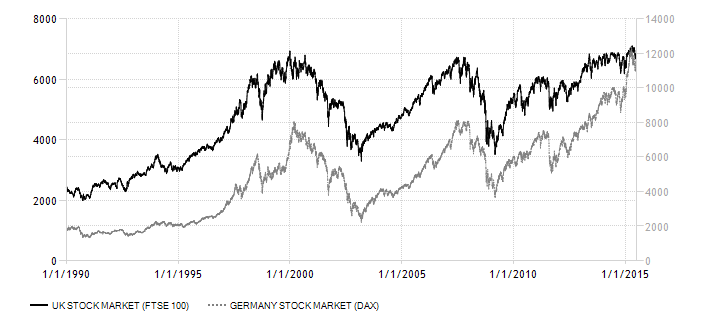
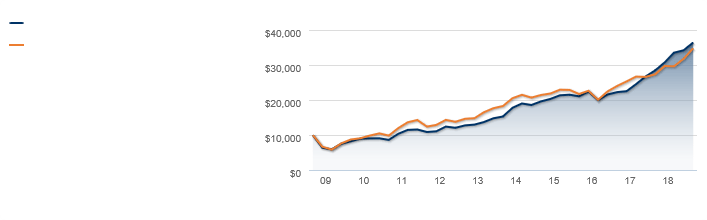
Small growth fund versus Blue Chips (T Rowe Price)

[This post was written on September 30. On October 10 there was an 800 point selloff on the DOW and another 350 expected today (Thursday October 11). The simplest example is all the thousands of Mutual Fund managers running around talking about their “well diversified portfolios”. My ass. After the sell off in US markets Wednesday, the entire globe had a virtually identical selloff. All markets, all sectors. It just doesn’t matter. CNBC then spent the day trying to scare people out of the market thus locking in their losses. That is utter nonsense. Buy at – 20%, buy more at – 30%, and if the market hits 13,000, put everything you own into it. And, after listening to the guests that Greg Hunter interviews on YouTube, he has confirmed my assertion that there is no free market. Equities are being manipulated by computer program traders, gold selloffs and currency manipulations.]